DRModule#
- class torchdr.DRModule(n_components: int = 2, device: str = 'auto', backend: str | FaissConfig | None = None, verbose: bool = False, random_state: float | None = None, compile: bool = False, process_duplicates: bool = True, **kwargs)[source]#
Bases:
BaseEstimator,Module,ABCBase class for dimensionality reduction methods.
Subclasses must implement
_fit_transform().- Parameters:
n_components (int, optional) – Number of dimensions for the embedding. Default is 2.
device (str, optional) – Device for computations.
"auto"uses the input tensor’s device. Default is “auto”.backend ({"keops", "faiss", None} or FaissConfig, optional) – Backend for handling sparsity and memory efficiency. Default is None (standard PyTorch).
verbose (bool, optional) – Verbosity. Default is False.
random_state (float, optional) – Random seed for reproducibility. Default is None.
compile (bool, default=False) – Whether to use
torch.compilefor faster computation.process_duplicates (bool, default=True) – Whether to handle duplicate data points by default.
- fit(X: ArrayLike, y: Any | None = None) DRModule[source]#
Fit the model from the input data.
- Parameters:
X (ArrayLike of shape (n_samples, n_features)) – Input data (or
(n_samples, n_samples)if precomputed).y (None) – Ignored.
- Returns:
self – The fitted instance.
- Return type:
- fit_transform(X: ArrayLike, y: Any | None = None) ArrayLike[source]#
Fit the model and return the embedding.
Handles duplicate data points by default: performs DR on unique points and maps results back to the original structure. Controlled by
process_duplicates.- Parameters:
X (ArrayLike of shape (n_samples, n_features)) – Input data (or
(n_samples, n_samples)if precomputed).y (None) – Ignored.
- Returns:
embedding_ – The embedding.
- Return type:
ArrayLike of shape (n_samples, n_components)
- transform(X: ArrayLike | None = None, **kwargs) ArrayLike[source]#
Transform data into the learned embedding space.
If
Xis None, returns the training embedding. When an encoder is set, new data is transformed viaencoder(X). For non-parametric neighbor embedding models (UMAP, LargeVis, …), pass the training data asX_trainkeyword argument.- Parameters:
X (ArrayLike of shape (n_samples, n_features), optional) – Data to transform. If None, returns the training embedding.
**kwargs – Additional keyword arguments passed to
_transform(). For non-parametric models,X_trainis required.
- Returns:
embedding_ – The embedding.
- Return type:
ArrayLike of shape (n_samples, n_components)
Examples using DRModule:#
Neighbor Embedding on genomics & equivalent affinity matcher formulation
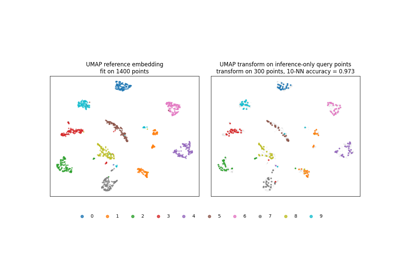
UMAP Non-Parametric Transform on Handwritten Digits